
The 213° week of the vigil
in front of WHO
It has been estimated that, as of today, there have been 2,059 nuclear weapons tests of which 531 were atmospheric tests.
What follows is not an exhaustive list, but the key elements that illustrate the way in which from the very start, nuclear technology, whether civil or military, has been a source of contamination of whole regions, and of conflict between peoples. With absolute contempt for both the physical and mental well being of human beings and of all other life forms, the industry has proliferated (there are now 9 nuclear powers), opening the way to civil nuclear power. This has arisen in spite of the many treaties signed, where the small print contains within it all the ways in which the central principles can be subverted.
Robert Oppenheimer (father of the first nuclear weapons test)
Kathleen Lonsdale on the subject of nuclear war
“There can be no victors, only vanquished”
“Mechanized civilization has just reached the ultimate stage of barbarism. In a near future, we will have to choose between mass suicide and intelligent use of scientific conquests [...]”
Albert Camus, 8th August 1945.

  |
 Some statistics on nuclear weapons tests
But the military use of nuclear material is not restricted to the bomb. 761 nuclear reactors have been fitted in 500 warships where there have been fires, leaks, operational breakdowns and even collisions like the one that took place between the French submarine “Le Triomphant” and the British submarine “HMS Vanguard” on 3rd February 2009. Seven submarines are resting on the seabed still armed with their warheads !!!! 
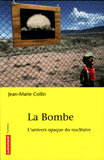
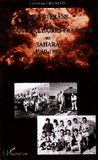
Apart from these losses, the military have disposed of an enormous quantity of nuclear waste at sea. We do not know what sort of state these containers may be in today, subjected as they are to salt water corrosion. They are a source of pollution to our marine environment and to our food resources!!! For more information click on military nuclear waste (in french). Today there are 9 nuclear powers, with Iran potentially about to become the 10th. At a rough estimate, accurate figures being very difficult to find, there are 1,670 tons of fissionable matter in the world of which 6.4 tons are held by France, but also 500 tons of plutonium (USA=92 tons, Russia=145 tons, France=6,44 tons) of which about half is weapons-grade material. Atmospheric and underground weapons testing All the nuclear tests that have taken place were either atmospheric or underground. Atmospheric : Suspended from towers, balloons or aeroplanes, these bombs were exploded at various altitudes dispersing radioactive elements, depending on wind direction, and thus contaminating not only the test site but also hundreds of kilometres of the surrounding area. On 15th January 1965, the USSR carried out tests in Kazakhstan, from which radioactive fall-out was found in Europe, mainly in Germany and Norway. Underground : These take place in artifically created underground tunnels, with the main tunnel containing the bomb. This tunnel is blocked before the explosion to ensure that the radioactive elements are contained. But many of the tunnels cracked open, for instance at In Ecker (the “Beryl” nuclear test on 1st May 1962 in the Algerian Sahara) emitting a cloud of toxic material. Even during normal functioning , radionuclides end up leaking through the rocks and even rising to the surface (so was confirmed the North Korean nuclear explosion of October 9th, 2006), either through microfissures in the rock (in the case of the nuclear tests “Plate”, “Eel”, “Des Moines” in 1962 and “Baneberry” in 1970 in Nevada) or through water infiltration. In the future, movements in the earth’s crust could cause more fissures in these underground cavities filled with radioactive material, and could result in contamination of the surface soil and air. Complementary tests or “cold tests” : “These complementary tests consisted of various explosive chemicals reacting together in such a way as to replicate a bomb. Officially only “neutral” material (depleted uranium) was used but most of the time other radioactive material, including plutonium, was added. During these tests (those that the French carried out at the In Ecker site in the Algerian Sahara [NDLA]) the chain reaction that was supposed to set off the nuclear explosion did not take place (or was very short lived). Instead, the radioactive debris and dust (uranium and plutonium) that was expelled has contaminated the test site and could present a serious threat to health.” -Bruno Barillot- Nuclear weapons testing sites 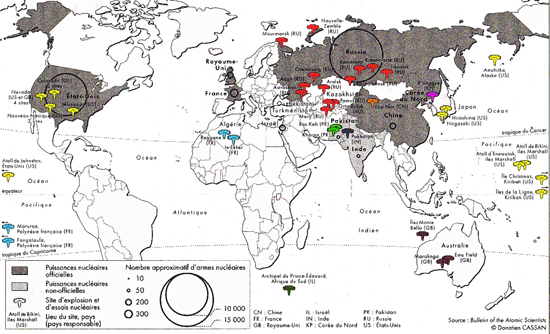 Jean-Marie Collin, “La bombe, l’univers opaque du nucléaire“, page 13 United Kingdom : Maralinga (British nuclear test site in Australia): 3000 square kilometres contaminated. Canberra forced London to clean up the site and this was carried out between May and August 1967. The earth was turned over, ploughed and the waste buried in 22 underground wells and covered with 50 cms of concrete. In the 1980’s new analyses of the area forced the British to undertake another clean up operation that took place in 1993: the soil was scraped off in an area covering 2.5 square kilometres, 350,000 cubic metres were buried at a depth of 5 metresThe radioactive pollution was in fact simply dispersed !!!!! or camoulaged !!!!. At the end of the 1950’s, the British undertook “complementary experiments“ ou “cold tests“ in Australia using small quantities of plutonium. These areas ares still contaminated today despite clean-up operations undertaken as late as 2000. USSR : For forty years starting in August 1949, the steppes of Kazakhastan became a kind of nuclear zone. It was used for nuclear tests, for uranium treatment and for burying nuclear waste. The total impact from nuclear explosions that have taken place in Kazakhstan is 45,000 times higher than from the Hiroshima bomb. Scientific research has shown that nearly 2.6 million people in Kazakhstan have been subjected to genetic mutation following prolonged exposure to ionising radiation. “A population suffering mental illnesses, cardio-vascular disease, congenital malformation and cancers. Even though the radiation is at a much lower level than before, some scientists warn that chronic exposure to low level radiation leads to genetic malformation. There is an enormous amount of radioactive material in these plains. Despite the danger, the local population use the earth to construct their houses and enclosures.” (Jean-Marie Collin, “La bombe, l’univers opaque du nucléaire“, page 38/39) Find out more about the Semipalatinsk nuclear zone : Article 1 et Article 2 Television programme about Semipalatinsk - France2 2010 (in french) Find out more about Kychtym (in french) United States : The Marshall Islands were “sacrificed for the good of mankind“ according to the Americans !!! On 1st March 1954, “Castel Bravo” was exploded off the island of Rongelap. . 1000 times more powerful than Hiroshima, it was just one of 67 nuclear tests carried out on the Marshall Islands, causing the disappearance of three islands.The island of Rongelap was only evacuated 51 hours later and the islanders were tested with a Geiger counter. In 1957, the Americans sent the Rongelap people back to their island. But the vegetation is contaminated with Caesium 137, Strontium 90 and Plutonium 239…the era of chronic contamination has begun. It is in the Marshall Islands that people talk about “jellyfish babies” and “bunch of grapes babies”. Others look like cyclops. There are many fœtal malformations, and some of these babies do not survive. There are many cases of cancer in the adults despite systematic ablation of the thyroid carried out by the Americans. Extract from a debate on 13/14th January 1956, held at the United States Atomic Energy Commission : “s’While it is true that these people do not live the way Westerners, or civilised people live, it is nevertheless true that they are more like us than mice“ !!!!!! In 1994, the Clinton administration opened some of the archives of the American department for Energy and found: * A report from 1958 where we find : “The islanders’ habitat will allow us to gather very useful ecological information on the effects of radiation. We can follow the various isotopes as they travel through the soil, the food chain, into the human body, where we will be able to study their distribution in tissue and organs, the biological half life and the rate of excretion ...“ * and in this report of Dr Conard : “The irradiated groups from the Marshall Islands constitute the best source for the observation of human beings. They represent the whole spectrum of levels of exposure: penetrating radiation, exposure of the skin to beta rays, absorption of radioactive material ....“ * and again, in another report : “And afterwards you return the population to the irradiated environment without any clean up operation. The inhabitants of Utrik [one of the Marshall Islands. NDLA] were sent home after three months. Those from Rongelap returned home after three years.“ * And again in this extract from a conference in 1967 : “We know that exposure to low level radiation increases the risk of leukaemia and skin cancer, but we do not have a thorough knowledge of the effects on humans“. Extracts from the article “ 7,000 Hiroshima ” by Fabienne Lips-Dumas, Revue XXI of summer 2009 - Read the whole article - in french -1,4Mo- France : In an official report, France admitted that the “Tamouré” nuclear test of 21st July 1966 reached La Paz a mere 48 hours after the test and that increases in radioactivity were registered in Bolivia, Argentina, Brazil, South Africa and Madagascar. With this limited information from an official source we can gain some idea of the geographical scale of the radioactive cloud and the area of contamination.  Suppose we multiply the area shown here by 2,059 (total number of tests) to show the full extent of the contamination caused by nuclear testing???? No, because not all tests share the same characteristics (atmospheric or underground). Perhaps by 531 then, the number of atmospheric tests? The answer is also no because the tests had different yields, and were exploded at different altitudes and in different climatic conditions (wind, temperature…). But we could allow ourselves a NON-SCIENTIFIC extrapolation on 10 tests (2,059 tests were carried out) in order to imagine the radioactive contamination worldwide due to these tests. 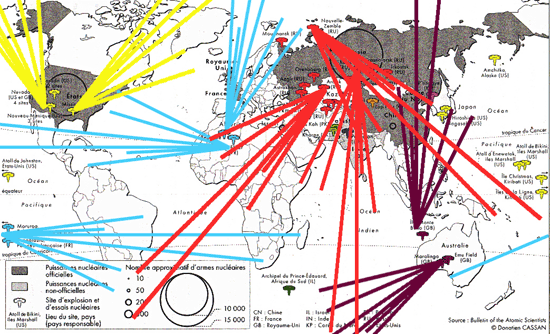 The french Deputy Christian Bataille drew up a parliamentary report (No 179 registered during the session 15-17th December 1997) in which we read : * In spite of the precautions that were taken, it is undeniable that all these tests created radioactive fall-out and generated nuclear waste. The only way we could have avoided the ecological and health consequences of these tests would have been to give up nuclear arms. That would have required the development of a different defence policy, but that is another debate altogether and has no place in the present report. * After seven years of conducting a variety of experiments at Reggane and In Ecker, these sites were returned to Algeria without putting in place any plans for monitoring the levels of radioactivity at the site in the future. Only the political circumstances that led to the abandonment of these two sites explains the indifference with which these problems were treated. * Why not recognise the situation clearly for what it is? National defence imperatives led us to damage, sometimes seriously, the environment and perhaps even to damage human health. Now is the moment to look at the situation with absolute honesty, to face up to the consequences and try to find a remedy where that is still possible. Full parliamentary report No 179 of Deputy Christian Bataille - See Part 2. (in french) Conditions in which the tests were conducted To carry out a nuclear test, states had to find an area that corresponded to one of the following criteria: a) a desert zone (16 sites in the USA ,14 in the USSR, and 1 in China, the Lop Nor desert). b) Or create a desert zone by deplacing the population (United States in the Bikini and Enewetak atolls). c) Or ignore the local population (USSR at Semipalatinsk in Kazakhstan, France in the Sahara, United Kingdom in their Australian protectorates of Emu Field and Maralinga) and ignore the military (it is estimated that 23,000 British soldiers were contaminated by nuclear tests). In certain tests states carried out experiments on artificially created villages (USSR), on materials and on men placed voluntarily near to the point of explosion : * USSR, 14th September 1954: atmospheric test near the village of Tostkopye (Urals) – 40 Kt – for a study on the consequences of radioactivity on materials and on 45,000 soldiers present at the site. * United States: 8 experiments involving 60,000 soldiers during Operation Crossroads, between the 1st and 25th July 1946. * France: on 25th April 1961, during the “Gerboise Vert” test, 195 soldiers of the 13th Mechanical Brigade were involved in manoevres only hundreds of metres from Ground Zero. National and international policy up to the present From the start of the nuclear age, the direction taken by the nuclear industry, both military and civil, in France, has never been discussed by parliament or in a public forum. The war in Algeria, and even more so, Algerian independence (Evian Agreement 18th March 1962), forced the French authorities to find new sites to carry out their tests. The Massif Central and the Bay of Argentella in Corsica were considered. The High Commissioner of the CEA, Francis Perrein, speaking about the Corsican site, stated that while underground testing had no effects “the tests would take place outside the tourist season“ !!!!! “There are military secrets that translate into budgetary silences. You will not find any figures within the military budget that tell you how much we spend on atomic weapons. This is exactly the way we want it.” Pierre Messmer, Minister of Defence from 1960 to 1969. On 8th December 1953, United States President Dwight Eisenhower, in his speech “Atoms for Peace”, ushered in the era of the “clean“ atom. Nuclear testing was even described as “peaceful” !!!! The French tests “Michèle”, “Monique” and “Georgette” (1961 to 1966) were used to study safety conditions for the use of nuclear technology in engineering !!!! This discussion “Atoms for Peace” formed the basis of 2 conferences (1955 and 1958 at Geneva) on “The peaceful application of atomic energy for civil purposes“ and for the American programme “Plowshare” (presented by Edward Teller). Plans included the creation of a second canal at Panama, artificial ports (Programme “Charriot”) and open cast mines. In total 27 “peaceful” tests in Nevada, Colorado and New Mexico were carried out as part of these programmes. In the USSR, 124 tests were carried out under the same banner of the “peaceful” use of the atom. The first explosion, on 15th January 1965, created a lake near the river Tchagan in Kazakhstan. 6.5 million tons of earth and rock were projected to a height of 2,500 metres and the radioactive fall-out was detected in Europe, mainly in Germany and Norway. A second project, the creation of a canal, between the Karia Sea and the Caspian Sea, involved 200 nuclear explosions. Only three explosions were carried out to create a lake 400 metres by 600 metres and 12 metres in depth near to the village of Krasnovichersk. And yet another failed Soviet project used nuclear explosions to heat the water table to 400 degrees, and then use this heat to turn turbines to produce electricity. The NPT, Non- Proliferation Treaty of 1st July 1968, actually played a role in the proliferation of nuclear weapons. It permitted countries that had no nuclear arms to develop a civil nuclear industry. Canada took advantage of this and sold two nuclear reactors to India. 2 years later, India carried out its first nuclear test claiming it was “peaceful”. Today, it is estimated that India has between 30 and 150 nuclear warheads as well as missiles (Prithvi, Agni I and II. The Agni II has a range of 2,200 Km). India has benefited from technology transfers from both America and France, these contracts proving very profitable for both States. In a similar way, France has made a profit from its technology transfers to Iraq. The CBTB (Comprehensive Test Ban Treaty) was ratified by France and the United Kingdom in 1998 and by Russia in 2000. But the CBTB does not ban simulation programmes or the improvement of nuclear arsenals. The father of the Pakistani bomb, Abdul Qaader Khan, was trained in Belgium and in Holland before being employed in a laboratory that gave him access to the Ureno Consortium that owned the ultracentifruge process for the enrichment of uranium destined for nuclear power stations. He left Holland suddenly in December 1975 (18th May 1974, the first Indian nuclear test!!!) with plans and an address book, full of the names of industrialists and scientists!!!!! Jean-Marie Collin believes Khan had established over the years, an extensive web of contacts in the nuclear black market. (“La bombe, l’univers opaque du nucléaire” page 144). North Korea, being the beneficiary of a substantial Soviet armaments programme and technology transfers, acquired considerable experience and expertise in missile production (Taepodong 2 with a maximum range of 6 000 km). In fact it was through sales of missiles that North Korea acquired hard currency. Through Abdul Qaader Khan, North Korea and Pakistan were able to set up a sort of technology “swop” nuclear technology for North Korea and ballistic missiles for Pakistan!!!!!! The various treaties have never managed to halt nuclear proliferation.Careful reading shows quite clearly how the small print within the text indicates the way to subvert the initial objectives. Besides, the nuclear powers never miss an opportunity to sell their technology, while declaring loudly and clearly, to the public at large that it is for civilian purposes only. In fact, there is no difference between civil and military nuclear technology other than the use to which it is put. Future policy India leases a Ballistic Missile Submarine (SSBN) from Russia and is about to sign a second contract. These arrangements obviously involve transfers of technology and therefore a much greater knowledge on India’s part in the nuclear field. In spite of all the treaties, the various nuclear nations continue to improve their weapons: by miniaturising their nuclear warheads or by increasing their power and also that of their delivery systems, the missiles for carrying the warheads. To illustrate the direction that the research has taken: * “Little Boy” the bomb used at Hiroshima: 4 tons with a yield of 15 Kt. * The nuclear warhead of the French missile M45: 120 Kgs with a yield of 100 Kt. * The Russian warhead SS-18 : 750 Kt. The simulation programmes perfected in the United States, Russia and France allowed them to continue their deadly weapons improvements in laboratories away from the public eye. In the past, the nuclear powers have not worried too much about the contamination of the nuclear test sites - and even less about the surrounding areas contaminated by radioactive dust carried by the wind - and they took no notice of local populations or of their own military personnel at the sites. Only the United States has a compensation programme for the military. In France today there is still no recognition of the issue, even though the military personnel continue to be contaminated. Between 1994 and 1997, neutron radiations at Île Longue (the French ballistic missile submarine base in Brittany) contaminated about 30 workers. If workers take action individually they usually end up losing their job. Silence is golden at State level, and the international organisations do not have much more to say. The fact is that to recognise the illness suffered by the military, as a consequence of their presence at nuclear test sites, would result in a breach in the nuclear industry’s wall of silence. This would risk damaging the whole industry and undermine the power and influence wielded by these same nations. This can be seen quite clearly in the agreement “WHA 12-40” signed between WHO and the IAEA that stipulates that the World Health Organization recognises that the International Atomic Energy Agency has the primary responsibility for encouraging, assisting and co-ordinating research on, and development and practical application of, atomic energy for peaceful uses throughout the world .. and that Whenever either organization proposes to initiate a programme or activity on a subject in which the other organization has or may have a substantial interest, the first party shall consult the other with a view to adjusting the matter by mutual agreement. (the statutes of the IAEA) The situation in France: Witness statements The witness statements of veterans and of the Algerian and Polynesian populations makes it clear that the French authorities knew perfectly well how devastating were the effects of radiation. Otherwise, why did they take so many samples (soil, plant and animal, in Polynesia and elsewhere), conduct experiments on animals (“Gerboise rouge” test) and also, register data about human health? ? The short term effects of large amounts of radiation were already known, as were the medium term effects, because the scientists had at their disposal the medical details of the radiation-induced illnesses suffered by the survivors of Nagasaki and Hiroshima. The genetic mutations caused by radiation were also known. Among the military and civilian personnel, some individuals “merited” protection (employees of the “CEA”, the Atomic Energy Commisariat) whereas others were treated as sub-human, others sub-sub-human and could be sent off to be “carbonised“ with no protection measures at all, like the Saharan and Polynesian populations. For De Gaulle, the bomb had to be exploded at least once, “we needed to provide proof that this bomb was absolutely terrifying and unstoppable(...), without Hiroshima, nuclear armament would have had no more effect than a water pistol“ (Christine Chanton, Les vétérans des essais nucléaires au Sahara, page 31). What emerges from these witness statements is that the attitude of the French army (also called “the great mute“) and of the nuclear lobby has never really changed. The veterans and in some cases their descendants have suffered all their lives from painful, sometimes very painful, health problems. They have no access to information about their presence at the nuclear test sites. Faced with continual rejection, lost or falsified documentation by the authorities, they receive no medical help or finance from the French State. The former nuclear test sites have now become radioactive waste dumps that continue to contaminate the environment. The local population who were not informed or protected at the time, were subjected to radiation directly through the explosions or indirectly through the “export” of materials from these sites, are still being contaminated by this “nuclear waste”. As regards the medical reports provided by the doctors in charge of the veterans today, some of them cast doubt or cannot prove any correlation between the pathologies suffered and the level of radiation experienced in the Sahara. Christine Chanton asks herself the following : “Can we blame the medical teams for their lack of certainty when the army refuses, under the guise of national security, to provide case notes [medical - NDLA] to those involved [the veterans - NDLA]?”. We could point out at this juncture that another reasons why doctors remain in ignorance of the relationship between radiation and health is due to the position taken by WHO, over the last fifty years (since the 28th May 1959, the date when the accord between the WHO and the IAEA was signed, in other words before the first French nuclear test). This denial by the international bodies is then passed on by successive French Health Ministers who become part of the information blackout and the abandonment of the veterans. A register of cancers was only put in place in Polynesia in 1980 but apparently the data that it contains are only reliable from 1998!!! There are no data relating to the period of the French tests. The register shows that Polynesia has one of the highest rates of thyroid cancer in the world. Current situation
Test site at Reggane in Algeria Test conditions “Gerboise blanche”, 1st April 1960 : “the explosion would be at ground level, (...) we were expecting that a very large crater would be formed and that there would be a great deal of contamination (...) in the area of the crater and that the contamination would be carried by the wind over 20 kilometres in one direction” explained Général Ailleret [Chief of Staff of the French Army, and later Chief of the Defence Staff, who directed the first two French nuclear tests in Reggane in Algeria - NDLA] Safety measures 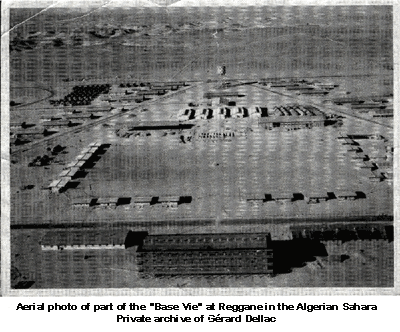 Extracts from the safety guidelines concerning personnel before the “Gerboise Bleue” explosion at Reggane (Algeria) on 13th February 1960 : “[...] Personnel whose presence is not absolutely necessary in the building at H hour should leave the building at the very latest at H-10 minutes and report to the stationing area, as instructed previously, near the police station at the entrance to Hamoudia [advance base 40 km from the command site at Reggane and 15km from the test site. NDLA]. All personnel should sit on the ground, with their backs turned away from the explosion, eyes closed and masked by one arm bent over. Those personnel who have been provided with special protective glasses will have their backs to the explosion, and will turn round one second after seeing the bright flash of light.
They will then count five seconds and then signal to the others that they can turn round. If you are outside during the test, you should try to avoid exposing naked skin (hands, neck, ears) to the explosion (put your hands in pockets, put on cap, neck flap on protective helmets that will be distributed to personnel who will be present at Hamoudia [...]”
Extracts from the safety guidelines concerning personnel before the “Gerboise Bleue” explosion at Reggane (Algeria) on 13th February 1960 : “[...] Personnel whose presence is not absolutely necessary in the building at H hour should leave the building at the very latest at H-10 minutes and report to the stationing area, as instructed previously, near the police station at the entrance to Hamoudia [advance base 40 km from the command site at Reggane and 15km from the test site. NDLA]. All personnel should sit on the ground, with their backs turned away from the explosion, eyes closed and masked by one arm bent over. Those personnel who have been provided with special protective glasses will have their backs to the explosion, and will turn round one second after seeing the bright flash of light.
They will then count five seconds and then signal to the others that they can turn round. If you are outside during the test, you should try to avoid exposing naked skin (hands, neck, ears) to the explosion (put your hands in pockets, put on cap, neck flap on protective helmets that will be distributed to personnel who will be present at Hamoudia [...]”But how seriously were these “recommendations“ for safety measures taken, when we read “as an army nurse, I went back to Point Zero soon after the explosion to collect the animals that we had left there the night before and could still see, not that far away, the “mushroom“ cloud moving away.“ (Guy V. “Les Irradiés de la République”, page 32) Studying the radiation “... As soon as we saw the flash, through our thin protection [closed eyes, head in arms - NDLA] set off in the plane and headed towards the cloud, passing through it about a quarter of an hour later. During the first passage - we were supposed to do it twice but my navigator Adjutant Allemant saw that all the Geiger counters were registering levels off the scale, long before we entered the cloud - the mission was accomplished.” (André P. “Les Irradiés de la République”, page 32). Radioactive waste These planes could now be added to the growing list of material (vehicles, tanks…) that was now radioctive, and were simply left around Point Zero and then brought to Reggane for analysis. “I noticed that the larger objects, sometimes of enormous size, were also classified “To be buried in the sand” (…) usually it was contaminated material that was simply buried in the sand”. (Jean-Paul D. “Les Irradiés de la République”, page 40) The health of military and professional personnel Military victims suffering a variety of illnesses tried to trace their medical case notes; “[...] At Pau, I asked for a copy of my military medical case notes, but what was odd was that no visit was mentioned, neither when I was drafted, nor during my active service, nor after demobilisation. It was as if I had never existed from a medical point of view, as a soldier called up to serve his country. I asked for and received a copy of the record of the dose I received at Clamart, but again, the odd thing was, it showed the results of tests up to May 1961. After that, there was no record even though I carried on working there until October 1961. Three blood counts were taken: the first when I arrived at the site (no date), on 28th March and in May 1961. After that, it’s a mystery…Nothing. The badge I have was never taken off me, so never read, and no-one asked for it back at the time of demobilisation.” (René J. in 2003, militaire “Décontaminateur“ en 1960 à Reggane. “Les Irradiés de la République”, page 30) Mme Christine L., widow of Bernard L, tells a slightly different story. She was “... called by the Commander of the 34th regiment of Génie de Sarrebourg. He made it quite clear, almost threatened me, that it was in my interest to keep quiet about what I had been told at the hospital at Percy [The consultant had told her : “your husband has a global medullary aplasia: it’s serious, he cannot carry on in the service; his case will go before a review board“. NDLA]. Then he made me make a statement under oath.” (“Les Irradiés de la République”, page 42). Roland W. went through a decontamintion chamber after the first test. The man in charge of registering the dose said : “Don’t be surprised if you never have children.” Health of the civilian population The abandoned materials were picked up by the local population after the French army had left. Conveniently, the traditional journey made by the Tuaregs from Kidak to Mali passes through Hamoudia, which was Point Zero !!!!! Test site at In Ecker in Algeria Safety measures. Noel R says “What makes me laugh is that the NCO’s registered positive in mR and the troops registered negative.” and he wonders “Why is the In Ecker site not mentioned in my military record?”. This difference in the treatment of men from different ranks is also reported by Pierre-Louis A. who says “[I] noticed that all of our work [opening a new road from In Ecker to Reggane. NDLA] was done without protective masks or overalls while the Atomic Energy Commisariat personnel wore them” and by Joel R. “We didn’t have a dosimeter, but everyday we were given new clothes and underwear. Why were the clothes from the day before destroyed?” (“Les Irradiés de la République“, page 83). The health of military and professional personnel Complementary experiments, also called “cold tests” ou “Operation Pollen” by the veterans, took place in the open air, the explosive devices placed on top of a metal pole about ten metres high. Joel R went to one of these sites the day after the test and “... wandered around doing nothing for half an hour before we got back in the lorry” and Paul L. was instructed to keep an eye on the movement of the radioactive clouds after the explosions. And the test that took place in May-June 1965 took place at 1 o’clock in the morning !!! Health of civilians 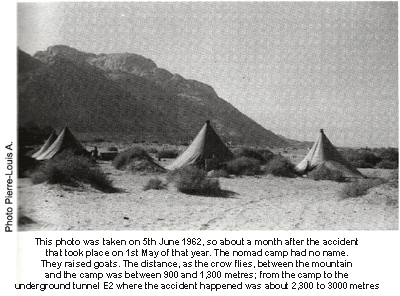 In Ecker 1st May 1962 “At exactly 11 o’clock, there was an explosion. [...] and things had started to calm down when we heard a much louder roaring, and so we turned our heads towards the hole behind which was where the tunnels were. Then we saw black smoke rising from it, like a steam train and in a very short time this had become a cloud. [...] We knew what had happened straight away; a leak. [...] the local people who lived about ten kilometres away to the East were contaminated. Some of them have already died. No-one even took the precaution to warn them or evacuate them. ... ” Michel R told us. (“Les Irradiés de la République”, page 68).
Among civilians at CEMO (Centre of Military Experimentation at the Oasis of In Ecker), there was the PLBT (Working Population of Bas-Touat), or as Jean-Pierre Panot describes more precisely “indigenous people recruited by the army from the oases between Colomb-Béchar et Reggane. This workforce was employed on construction and where I was, they were employed to load and unload lorries”. General Ailleret added that the construction of the base at Reggane “needed a large workforce and it was tempting to recruit locally given that the work was unskilled”. Is there any record of these civilians? Were they present when the tests took place? Did they receive any medical follow-up? And in the following years? Christine Chanton and Solange Fernex reply in the negative. What became of these civilians? In all probability they faced a similar or a worse fate than the French veterans !!!!! Solange Fernex took witness statements from Tuareg people who have not had any more children since the years they spent at the nuclear sites. Others report women miscarrying in about the 5th or 6th month of pregnancy. Other testimony leads us to think that the local population - mainly nomadic people - were evacuated during the first tests but returned very soon after to the site. In any case, following the tests they were given no information or protection. Not to mention any medical follow-up !!!!! Dismantling the French test sites in Algeria Information about the dismantling of the sites is sparse. Witness statements often talk about burial, including even lorries and aeroplanes!!! Some of the bases and test sites were surrounded by barbed wire, but this was often stolen. Items were stolen from the bases and even the tunnels where the tests took place. This means that radioactive metals were probably taken from the site, and exported mainly to Morocco. It is worth remembering what the French Deputy Christian Bataille said in his parliamentary report No 179 : “After seven years during which a variety of nuclear tests were undertaken, the two sites at Reggane and In Ecker were handed back to Algeria without putting in place any kind of system of monitoring or follow-up of the levels of radioactivity. Only the political circumstances during which these two sites were abandoned can explain the indifference with which these problems were treated at the time.” Moruroa and Fangataufa in Polynesia French policy in Polynesia On 6th February 1964, the two atolls were given to the French state (Deliberation no 64-27) stipulating that “when activities come to an end at the research centre in the Pacific, the Atolls of Muroroa and of Fangataufa will automatically return at no cost to the Territory [Territory of Polynesia. NDLA] in the state in which it is found at that time without compensation or reparation of any sort by the (French) state. Any buildings dating from that period, or materials left at the site, will become the property of the Territory, without compensation“. Even before they started the tests, the French government had no plans to clean up the site and expected Polynesia not only to take charge of this radioactive dustbin but to do it without any compensation or financial aid!!!!! Yet in 2003 the Atolls were still designated an official military site with access forbidden to the public !!!!! But the Polynesians were not stupid. Here is an extract from a speech given by John Teariki, Deputy of French Polynesia, made on 7th September 1966 in Tahiti, with General de Gaulle present : “the creation of this organisation [the Pacific Centre for Experimention in Polynesia. NDLA] and its installation here on our land, (has been) achieved without any prior consultation with the Polynesian people .... Your propaganda tries to deny the evidence, claiming that your nuclear and thermonuclear explosions would present no danger to us.“ Polynesia was defenceless in the face of the arbitrary power of the French state and had to accept these research centres. From 1966 to 1996 (in 1963 the United States, the USSR and the UK signed the Treaty of Moscow, forbidding atmospheric nuclear testing), 46 atmospheric tests took place and 147 underground tests both in the coral circle of the Atolls and in the lagoons. The IAEA stated that of these 147 underground tests, 26 were not “contained”, in other words radioactive material escaped during these tests. Bruno Barillot (“les Irradiés de la République”, page 127) has published an official document dating from 5th December 1966 (from the archives of the Oceanic Asia Directorate of the Minister for Foreign Affairs, atomic energy service, French Oceanic Possessions page 29, 1st inset) in which we read “We know that in several atolls in Polynesia and in Latin America, particularly in Bolivia, radioactive fallout was more significant than predicted, although not presenting any danger for public health. It is possible that other regions, in particular to the West of the test sites, were also affected, but given the insufficient means to monitor the situation, it would be almost impossible to evaluate any increase in radioactivity. These phenomena are due mainly to the dominant winds in the South Pacific whose irregularity, speed and change of direction depending on altitude, explain not only the unexpected dispersal towards the West of some of the radioactive clouds, but also the speed with which part of the cloud was blown East and reached South America. This explains how the first increases in radioactivity from the Tamoure test (21st July 1966) were detected in La Paz only 48 hours after the test. [...] whereas increases were detected in Bolivia, Argentina, Brazil, South Africa and Madagascar, countries who expressed no interest in our nuclear testing. [...]“ It&#&46s like a bad dream : In one case, there has definitely been an increase in radioactivity but there have been no ill effects. In the next case, we don’t have the means to measure it, whatever it is, so it’s neither here nor there and has to be written off. And then it’s the wind’s fault for changing direction. And finally, it’s not serious because the countries concerned have made no objection !!!!!!!!!! In the early 1970’s, Australia and New Zealand “dragged” France before the international Court at The Hague. France responded with the publication of a white paper, presenting the “proof” of “the innocuousness of nuclear testing. The amount of radioactive elements produced during our experiments are in reality so insignificant that they could be considered negligeable ....“. In other words “Move along, there’s nothing to see here” or rather, “there’s nothing to measure here” !!! An AFP news report from Adelaide on 7th July 1971 : “Rainwater collected in Adelaide(Australia), after the nuclear tests that took place in June in the Pacific, revealed levels of radioactivity higher than anything ever recorded in South Australia“. And DIRCEN [Directorate of the Centres for Nuclear Experimentation- France. NDLA] replied “rainwater is not usually used for drinking water. Before it is consumed, it passes through the soil which filters it and mixes it with other water that dilutes its effects ... “ So too bad if it pollutes the soil and underground water supply!!! And too bad for the inhabitants of the Pacific islands who drink rainwater directly, because some of the Atolls have no underground water supply !!! Safety Regulations The regulations concerning safety vary enormously. At the heart of the CEA (French Atomic Energy Commission), the regulations were quite strict, but it was very different in the army and depended on grade, status (conscripted or regular) regiment and assignment. For some, it could be summed up as “Nothing“ (no training, no information, no protective clothing, no follow-up) for others it involved a shower, and sometimes washing with Teepol detergent. Only a small number of people were measured using a dosimeter and the recording of these doses was totally unreliable. More than 40 years afterwards, many military personnel have no way of knowing what doses they received, with the SPRA (Army Radiological Protection Service) replying to requests with “no dosimeter level recorded”, “results illegible”, “our research has found nothing” or “your medical records indicate a negative result”. Health of military and professionl personnel “No medical case notes have ever been sent to doctors working in the civilian sector. It was claimed at the time that “the technology was perfectly well controlled in Polynesia ...””. “National security” of course!” confirmed Jean-Claude Lamatabois (“Les Irradiés de la République“, page 124). Jacques R., whose mission was to photograph the mushroom cloud as it developed, was dressed in shorts and short sleeved shirt with a pair of dark glasses as his only protection. Jean-Francois L. went through an emergency decontamination at “Blavet” while the sailors, living there permanently, went shirtless. Phillipe B. dived into the lagoons of Moruroa and Fangataifa to take samples of coral and fish, wearing only standard equipment. Daniel G. came out of the protected building ten minutes after the tests to take weather readings. “We were close to contaminated areas that were demarcated only by red and white ribbon attached to posts (...) I did my work and didn’t ask any questions, because we trusted our bosses who said we had nothing to worry about (...) As before, the Polynesian workforce worked with no protection whereas the personnel of the CEA [CEA : French Atomic Energy Commisariat. NDLA] who visited the work sites were equipped with protective suits and carried a dosimeter. At the time, the water we drank came from desalinated sea water while the CEA personnel drank bottled water (Evian).” (“Les Irradiés de la République”, page 184). “At some work sites [recovering dead marine-life from the lagoon at Moruroa, less than 40 hours after a nuclear test. NDLA], the SMSR (Joint Service of Radiological Safety) went in first. They were equipped with hot suits [complete overalls with shoes, gloves and masks. NDLA]. Then they told us : “it’s clean” and afterwards we would work there without special clothing.” (“Les Irradiés de la République”, page 186) But sometimes instructions were quite clear, as Dominque B. who was in charge of regulating the lead-lined container and of monitoring the personnel : “To be precise, we were given orders to keep quiet if a test was positive, in particular if it concerned caesium, and the adjutant told us specifically that these orders came from above and that anyone testing positive (often Tahitian) was condemned to developing cancer in the next twenty years.” (“Les Irradiés de la République“, page 175) During recovery operations to pick up buoys and sounding equipment in the Moruroa lagoon, two hours after a nuclear test, the surface of the water was yellow, smelled horrible and had bubbles of gas exploding on the surface. None of us had masks and “The Commandant of the DP told us to shut up, say nothing, about these gas leaks. We were afraid of reprisals, on his part (being dismissed from the Navy etc). This matter was declared classified. None of the men in the team had any medical visits“ statement from Jean L. M. (“Les Irradiés de la République”, page 198). Health of the civilian population 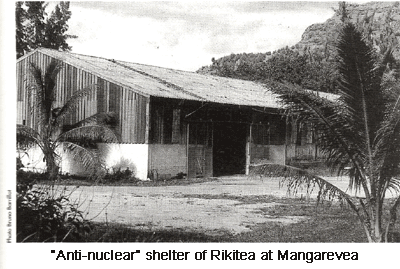 Etienne Tehemu was “... witness to the helicopters circling above my island [Tureia, 100km from Moruroa. NDLA], collecting particles in the radioactive clouds. I saw yellow clouds passing over the lagoon on my island. I also witnessed toxic chemicals being emptied in the reef. These products came from the preparation for weather balloons, and they contaminated the fish with toxins so they could not be eaten.” (“Les Irradiés de la République“, page 206)
“When the military arrived, half the population worked for them, whether it was fishing, growing vegetables, they paid very good wages. But after the tests started they stopped buying the fish, and soon after, they stopped buying the vegetables too, even though they continued to buy their vegetables from Tahiti.” (“Les Irradiés de la République”, page 210) “Before the nuclear tests, many scieintists came to Mangareva to collect all sorts of samples: soil, plants, animals, fish, water…. Others came just to observe. They looked at birds and fish and took a lot of notes. After the tests began, the military came at least twice a year to take samples. (...) They never explained why they were collecting samples or what were the results of their analyses. Later another boat landed on our island, carrying a machine called a “spectro”. As soon as the boat was docked, everyone had to assemble and go on board. There was background music playing when they put us through the machine and after a few minutes we came out. This was done two or three times. A few people were worried and suspicious, but again, no-one told us anything. Another team of doctors came, first military and then civilian. They took blood, urine, faeces and examined us. If anyone refused to be examined, the police came to fetch them.” (“Les Irradiés de la République”, page 212) Environmental consequences What did Gilles.A. know, working as part of the team that brought supplies to the islands? “We didn’t know anything in fact, we weren’t told about the different tests that were being done or were being planned”. And the only recommendation he received was “to protect your eyes” and to make sure that supplies arrived “with no particular restrictions….no special protective measures taken either individually or collectively”. But he wondered “why fresh water needed to be brought to islands where, before the arrival of the National Marines, people lived without any problems of water supply”. Nor why the Gambier island, “islands that could produce up to three harvests of tomatoes in the year”. Tanemaruatoa Michel A. lived on the Reao atoll in the Tuamotu in 1966. In July, the inhabitants were forced to spend three days in a nuclear shelter. “When we came out after the three days was up, I noticed some of the vegetation had changed: the coconut palms had turned a bit yellow and a few days later all the fruit dropped. (...) I visited “hot spots” all the time to take samples from the soil and the sea for biological analysis (...) I was put in charge of a garden with contaminated earth that had been brought from Fangataufa. The Joint Service wanted to know what would happen to vegetables growing in contaminated soil” (“Les Irradiés de la République”, page 175). “Around 1970-71, a new phenomenon appeared. It only lasted a few months but it was more frightening than the poisoning of the fish [referring to food poisoning from eating fish caught locally. NDLA]. There were dead fish stranded on the bank. At first it was only certain species of big fish but later, millions of fish of all sizes and all species ....Some species were completely decimated and are now extinct. Millions of shellfish are dead as well. We had to take samples to send to specialists to be analysed and specialists came to Mangareva. Either they didn’t discover the cause or they simply didn’t tell us the results of their analyses.“ Repored by a woman in Mangareva (“Les Irradiés de la République”, page 211) 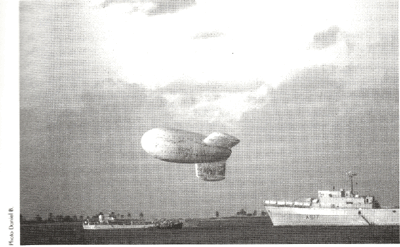 “I was also present, just after the atmospheric tests finished in 1975 to 1976, when the waste products from the CEA’s [CEA : French Commissariat of Atomic Energy. NDLA] radio-chemical laboratories were discharged into the ocean. Tons of waste, in lead containers.... were dropped into the ocean from helicopters. Afterwards we couldn’t eat the shellfish or the fish caught in the sea beyond the reef” (“Les Irradiés de la République”, page 187)
Some ships sailing between Papeete and the Atolls would use the water from the lagoon as ballast, water that was contaminated from the tests, and later it would be discharged into the port at Papeete, polluting it. Troops were transported back to the capital several times when new troops and supplies would be loaded. Were they ever decontaminated? The “Alpha” force that “protected” some of the nuclear tests represented 40% of the potential French marine force. Some ships involved in the experiments and monitoring of the nuclear tests returned to the lagoons only an hour after the explosion. A number of these ships, often at the end of their lives and mostly radioactive were sunk in the waters of the Atolls. Conclusions about the military period 1945 to 2010 The health consequences of these nuclear activities are numerous and varied. We do not all, in fact, respond in the same way to radiation, some people being more susceptible than others (genetic factors, nutritional, childhood environment…) Radiation exposure can be external or internal (through inhalation or ingestion), the dose received varies between one group of individuals and another, there can be repeated exposure also. The effects of exposure to radiation do not appear for many years. In the case of the veterans, it involved a very young population (those called up to the armed forces) uninformed, not to say disinformed. Many of these soldiers have fallen ill with a variety of illnesses: loss of hair, impotence, chronic sigmoiditis with hematochezia (rectal bleeding), microvesicular steatosis of the liver, muscle stiffness, bronchitis, carcinomas, difficulty in walking, multiple fractures due to weakness of the bone, high blood pressure, loss of teeth, nummular excema, myeloma… and even premature death. Some soldiers say that children conceived after their tour of duty at the nuclear experiment sites, suffer illnesses, some more serious than others. Some have died, sometimes at a very early age (some within hours of birth) often due to malformation. Other witnesses say that their grandchildren have health problems !!!! “I gave birth to a premature baby that they took away in a military plane to be hospitalised in Tahiti. The next day, we got a message to say that the baby had died. No-one ever returned the body to us and we never received a death certificate, which means that officially the baby is still alive; (...) Even now, many years later, I have nightmares about it.” (“Les Irradiés de la République”, page 212) Unfortunately, the procedures put in place by the army and the nuclear industry have not changed : a) Say nothing about the missions undertaken by military or civilian personnel. b) Tell people who are employed at contaminated sites that radiation has no ill effects. c) Take measurements of radiation dose from people who are not involved in any experiments. d) “forget” to take measurements of contamination of people during experiments.. e) Classify all archives as “Secret” forbidding anyone from consulting them. f) Refuse to undertake epidemiological studies of populations present at the nuclear tests or of their descendants. g) Claim that in the absence of epidemiological studies, it is impossible to find a causal relationship between the illnesses suffered by people and their exposure to radiation. h) Dispose of contaminated materials often straight into the natural environment (burial in the Sahara or scuttling of ships in Polynesia) even if it creates numerous contaminated sites. i) Put forward other causes for the illnesses suffered by exposed people or their descendants. In 2009, a debate began at the French National Assembly about compensation for the veterans of the nuclear tests in the Sahara and in Polynesia, after years of struggle on the part of associations like AVEN and “Moruroa e Tatou”. The debate about the proposed legislation is dragging on, with the French government trying to establish as limited an application as possible and the associations struggling to put forward the rights of the veterans, some of whom have already died. Read the analysis (in French) of Bruno Barillot (AVEN) on the proposed french legislation Bibliography on this theme Books
parliamentary report Parliamentary report No 179 of french Deputy Christian Bataille - See part 2 Press Tahiti Presse du 28/04/2009 : Procès du nucléaire - Bilan et perspectives Le Nouvel Observateur du 23/04/2009 : La dernières guerres des sacrifiès Le Point du 19/01/2007 : Le Secret des irradiés du Sahara Le Point du 16/01/2007 : Paysage après les essais Le Monde du 28/01/2006 : Un rapport conclut à la nocivité des essais nucléaires français HNS Info du 25/07/2002 : On reparle des essais nucléaires français à Mururoa Le Nouvel Observateur du 05/02/1998 - Sahara : Les cobayes de “Gerboise verte” WebSites (in french) Moruroa, Mémorial des essais nucléaires français Le Centre de Documentation et de Recherche sur la Paix et les Conflits (CDRPC) Observatoire des armes nucléaires françaises AVEN, Association des Vétérans des Essais Nucléaires “Moruroa E Tatou”, Association des anciens travailleurs et victimes de MORUROA et FANGATAUFA laradioactivite.com Info Nucléaire Movies and Documentaries  GERBOISE BLEUE Djamel Ouahab | ||||||||||||||||||||||||||||||||||||||||||||||||||||||||||||||||||||||||||||||||||||||||||||||||||||||||||||||||
 Site map
Contact the Webmaster
Site map
Contact the Webmaster