

The 213° week of the vigil
in front of WHO
|
1- History and structure of the UN 2- History and role of WHO 3- History and role of the IAEA 4- The Agreement WHA 12-40 between WHO and IAEA |
History and Structure of the UN
The Treaty of Versailles signed in 1919 set up the League of Nations, an international organisation whose aim was to keep the peace in Europe after the First World War. The objectives of the LoN included: disarmament; the prevention of war through the principle of collective security; the resolution of conflicts by negotiation and by an improvement in the quality of life world wide. Benito Mussolini said : “The League of Nations is very effective when the sparrows cry, but not at all when the eagles attack.”
After some considerable successes and a few failures in the 1920’s, the League of Nations proved unequal to the task of preventing the aggression of the Axis powers in the 1930’s. The start of the Second World War showed that the LoN had failed in its primary objective which had been to avoid a new world war. The United Nations Organisation replaced it at the end of the War and inherited from it a number of agencies and organisations.
| 21st August 1944 | The opening of the Dumbarton Oaks Conference, bringing together the United States, China, The United Kingdom and the USSR. | ||
| 25th April 1945 | Conference in San Francisco bringing together 51 nations with the aim of establishing a charter for the United Nations. | ||
| 26th June 1945 | The United Nations Charter is signed by 51 nations. | ||
| 24th October 1945 | The United Nations Charter is ratified by 51 nations. OFFICIAL BIRTH OF THE UN | ||
| 22nd July 1946 | Creation of WHO. | ||
| 10th December 1948 | The UN adopts the Universal Declaration of Human Rights. | ||
| July 1957 | Creation of the IAEA. | ||
| 28th May 1959 | Signing of the Agreement WHA 12-40 between WHO and IAEA. |
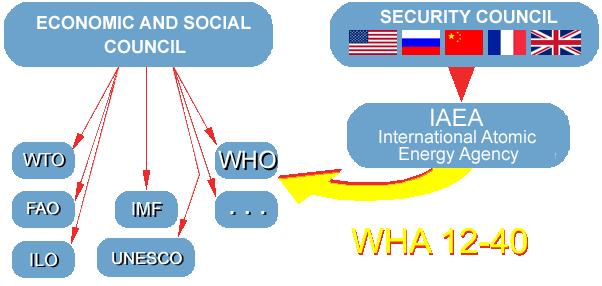
The UN is divided into 7 organisations, of which two are of interest to us, the Economic and Social Council and the Security Council. The “Economic and Social Council” oversees ALL the United Nations agencies with the exception of the “IAEA”. In fact, the IAEA is the only agency that reports directly to the “Security Council” which is made up of representatives of 15 countries, of which 5 are permanent members of the Council : the United States, the Untied Kingdom, the Russian Federation, China and France. These 5 nations are all nuclear powers, both civil and military, and almost all are exporters of nuclear technology.
The 10 remaining members (or countries) have a mandate which lasts for 2 years.
The influence of these 5 permanent members of the Security Council on policy making within the IAEA is enormous and ongoing. With no counterbalancing power, it is almost impossible to claim that the IAEA has an objective view of the nuclear industry and the consequences of its use.
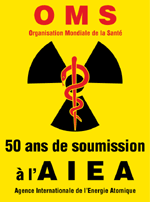
On 28th May 1959, the IAEA (not yet two years old !) and WHO signed an agreement referred to as “WHA 12-40” which, though it might, on paper, appear balanced and reciprocal, in practice, puts WHO in a subordinate position to the IAEA.

 History and role of WHO
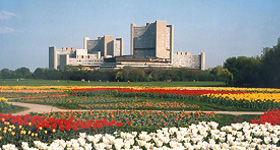
Created on 22nd July 1946, at the end of the Second World War, WHO has its headquarters at 20 avenue Appia in Geneva (1211). Currently WHO has 194 member countries.
From 1988 to 1998, the Director General was Doctor H. Nakajima (who appears in the documentary “Nuclear Controversies” by Wladimir Tchertkoff.)
The current Director of WHO is Madame Chan. We present here some passages from WHO’s constitution.
* Health is a state of complete physical, mental and social well-being and not merely the absence of disease or infirmity.
* The enjoyment of the highest attainable standard of health is one of the fundamental rights of every human being without distinction of race, religion, political belief, economic or social condition.
* Informed opinion and active co-operation on the part of the public are of the utmost importance in the improvement of the health of the people.
* The health of all peoples is fundamental to the attainment of peace and security and is dependent upon the fullest co-operation of individuals and States.
Our collective Independent WHO asks the following questions:
* Why are the results of research by independent scientists like Professor Youri Bandajevsky, Alexei Yablokov, Professor Nesterenko and many others, ignored by WHO?
* Why are “the views of professionals” working in health centres and hospitals in the contaminated zones swept aside?
* Why do we never hear the messages coming from pressure groups and ordinary people?
* Why is the precautionary principle not being implemented?
But the most painful questions arise when we look at the way the agreement between WHO and IAEA affects work in the field.(See below).
Access to the official WHO site
 History and role of the IAEA
Created in 1957, the IAEA has its headquarters in Vienna (Austria) and its Director Genera is Mohamed El Baradei. The Nobel Prize 2005 was awarded to Mohamed El Baradei and the IAEA. The Norwegian Nobel Committee singled out for praise “their efforts to prevent the military use of nuclear energy”. We present here some passages from the statutes of the IAEA.
* To encourage and assist research on, and development and practical application of, atomic energy for peaceful uses throughout the world.
* To make provision, in accordance with this Statute, for materials, services, equipment, and facilities to meet the needs of research on, and development and practical application of, atomic energy for peaceful purposes.
* To establish or adopt, [...], standards of safety for protection of health and minimization of danger to life and property.
Some comments :
* The history of the atom started with the military who were determined to have the bomb. They still play a major role in the nuclear domain despite the signing of the Non-Proliferation Treaty.
* The statutes of the IAEA make very clear the dangers in the use of atomic technology.
* The IAEA, in so far as it provides products and services, works for and alongside the nuclear industry.
* How can a body that plays an active part in such a sensitive industry dictate the norms for health and safety?
Access to the official IAEA site
 The Agreement WHA 12-40 between WHO and IAEA
It was approved on 28th May 1959. We reproduce here the relevant extracts but you can also read the document in its entirety.
* The International Atomic Energy Agency and the World Health Organization recognize that they may find it necessary to apply certain limitations for the safeguarding of confidential information furnished to them ...
* the Secretariat of the International Atomic Energy Agency and the Secretariat of the World Health Organization shall keep each other fully informed concerning all projected activities and all programmes of work which may be of interest to both parties.
* It is recognized by the World Health Organization that the International Atomic Energy Agency has the primary responsibility for encouraging, assisting and co-ordinating research on, and development and practical application of, atomic energy for peaceful uses throughout the world without prejudice to the right of the World Health Organization to concern itself with promoting, developing, assisting, and co-ordinating international health work, including research, in all its aspects.
* Whenever either organization proposes to initiate a programme or activity on a subject in which the other organization has or may have a substantial interest, the first party shall consult the other with a view to adjusting the matter by mutual agreement.
* THE REVISION OF THE AGREEMENT : If agreement on the subject of revision cannot be reached, the agreement may be terminated by either party on 31 December of any year by notice given to the other party not later than 30 June of that year.
Compared with other agreements made between various UN agencies, there is nothing unusual in the way this document has been drafted, but we would point out that, in practice, it puts WHO under the yoke of the IAEA.
* WHO must notify the IAEA of any plans to undertake research and then either work with, or yield the research to the IAEA.
* The Agreement specifies that neither of the two agencies should be disadvantaged by the other: thus the business interests of the IAEA should not suffer ...
* In 23 years, no social or medical programme, worthy of the name, has been set up in the contaminated areas of Chernobyl.
* In the nuclear nations, epidemiological studies are rare.
* In countries like France, there is a total blackout on all civil and military nuclear activity.
This Agreement poses a clear conflict of interests and is the motivating factor behind our demand to see it revised.
 Site map
Contact the Webmaster
Site map
Contact the Webmaster