
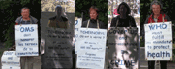
The 213° week of the vigil
in front of WHO
of the World Health Organization (WHO)
Initiators:
- Fran Baum, Prof. Dept of Public Health, Flinders Univ. Co-Dir. People’s Health Movement (Australia)
- Susanna Beretta-Piccoli, Pharmacist, Federal Diploma, Federation of Swiss Pharmacist (Switzerland)
- Rosalie Bertell, Ph.D, Epidemiologist, Past Pres. Int. Instit. Concern for Public Health, Regent Int. Physicians for Humanitarian Medecine Geneva, International Science Oversight Committee, Ass. of Organic Consumers (USA)
- Elena.B. Bourlakova, MD. Prof. Semenov Inst. of Clinical Physics, Acad. of Sciences, Moscow. (Russian Fed.)
- Christelle Braconnot, Nurse, French Diploma (France)
- Marina Carobbio, MD. Member of Parliament (Switzerland)
- Blanche Dubois, Nurse, French Diploma (France)
- Lena-Marie Glaubitz, Medical Student (Germany)
- Liliane Maury Pasquier, Midwife, Senator (Switzerland)
- Maria Roth-Bernasconi, Nurse, Member of Parliament (Switzerland)
- Youri.I. Bandajevsky, MD. Prof, ex-Rector, Faculty of Medicine, Gomel (Belarus)
- Abraham Behar, MD, Pres. As.Française Médecins Prévention Guerre Nucléaire, Past Pres. IPPNW Europe (France)
- Chris Busby, Epidemiologist, Scientific Secretary, European Committee on Radiation Risk, (United Kingdom)
- Denis Fauconnier, MD. General Practitioner, Corsica (France)
- Michel Fernex, MD, Prof. Emeritus, Faculty of Medicine, Basel, Pres. Enfants Tchernobyl Belarus (France)
- Pierre Flor-Henry, MD, Prof, Dir. Psychiatric Services for Adults, Hospital of Alberta (Canada)
- Claudio Knüesli, MD, Oncologist, Pres. PSR/ IPPNW Switzerland (Switzerland)
- Andreas Nidecker, MD., Prof. Radiology, Faculty of Medicine, Basel (Switzerland)
- Claudio Schuftan, MD. Int. Public Health Consultant for WHO, UNICEF, EC. Co-Dir, PHM (Vietnam)
- Hani Serag, MD, Public Health Researcher, International Coordinator, People’s Health Movement (Egypt)
- Joël Spiroux, MD, Environmental Health Expert, Union Rég. médecins libéraux, Hte Normandie (France)
To à Madam Chan, Director-General, WHO
and to our Minister of Health --------------------
The World Health Organization (WHO) works towards the resolution of public health problems. To this end, it is mandated by its Constitution, adopted 7th April 1948, “to assist in developing an informed public opinion”. However, since the WHO/IAEA Agreement (WHA12-40) was signed on 28 May 1959, the WHO appears to be subordinate to the International Atomic Energy Agency (IAEA), as regards the risks associated with artificial radioactivity, in particular the study of the health consequences of the explosion at Chernobyl.
In the past, WHO was paralysed in its campaign against passive smoking because of the pressure exerted by the tobacco lobby. In the same way, WHO is paralysed by its links to the IAEA, an institution that ranks highest in the UN hierarchy. This agency reports to the UN Security Council where it coordinates the promotion of commercial nuclear energy. The other UN agencies and the WHO report only to the UN Economic and Social Council.
The principal statutory objective of the IAEA is to accelerate and enlarge “the contribution of atomic energy to peace, health and prosperity throughout the world”. However, the 1959 Agreement ignores the conflict of interests which results from this. It stipulates that “Whenever either organization proposes to initiate a programme or activity on a subject in which the other organization has or may have a substantial interest, the first party shall consult the other with a view to adjusting the matter by mutual agreement”. The Agreement also provides (Article III) for the application of “certain limitations for the safeguarding of confidential information”. This confidentiality led to the non-publication of proceedings of the WHO Conference in Geneva on “The health consequences of Chernobyl and other radiological accidents” (20-23.11.95.). The 700 participants still await the Proceedings which were promised for March 1996. Dr Nakajima, who was Director General of WHO at the time of the conference, confirmed in 2001, in an interview with Swiss Italian Television, that censorship of these proceedings was due to the legally defined relations between the WHO and the IAEA.(1).
As regards research projects, “adjusting the matter by mutual agreement” implies removing all freedom from WHO in the area of nuclear accidents. Thus, following the accident at Chernobyl, we read, “Beginning of 1990: WHO was invited by the Minister of Health of the Soviet Union to set up an international aid project. May 1991. Completion of the International Project by the IAEA”.
Thus it was the IAEA, rather than WHO, that provided the plans for a project requested by the Minister of Health of the USSR. This explains why genetic damage, known to be a critical measure since the publication in 1957 of a WHO report entitled, “Genetic Effects of Radiation on Humans”, was omitted, while caries and dental health were accorded a higher priority by the IAEA(2).
As a result, it is the promoters of nuclear energy, the IAEA, with the agreement of UNSCEAR(3) and the ICRP (International Commission on Radiological Protection), who provide information to the United Nations on the health problems of Chernobyl. In 1996, they cited 32 deaths from radiation; in 2005, they conceded about 50 deaths and 4000 thyroid cancers in children,(4) whilst taking no account of the death and morbidity rate among the 600,000 to 800,000 “iquidators” that took part in the clean-up operation at Chernobyl.
It is urgent that WHO provide assistance to the one million children condemned to live in an environment contaminated by radionuclides from Chernobyl. Up to 90% of the contamination is internal, and the rest external. Some internal organs accumulate concentrations of radionuclides. The resulting chronic irradiation has damaging effects on health. In Belarus today, 85% of the children in contaminated areas are ill; before the explosion, this figure was 15%(5). In 2001, the Chief Medical Officer of the Russian Federation stated that out of 184,175 registered liquidators, 50,000 were ill and 15,000 had already died. The Ukraine provided 260,000 liquidators. According to a press release from the Ukrainian Embassy in Paris, dated 25 April 2005, 94.2% of them were ill in 2004. At the Kiev conference in 2001, we learned that 10% of these workers, half of whom were young military recruits, had died, and one third was seriously ill. The Ukrainian Embassy stated that 87.85% of the inhabitants of the contaminated territories were ill. That proportion increases every year.
Hundreds of epidemiological studies, in Ukraine, Belarus and the Russian Federation(6), have established that there has been a significant rise in all types of cancer causing thousands of deaths, an increase in infant and perinatal mortality, a large number of spontaneous abortions, a growing number of deformities and genetic anomalies, disruption and retardation of mental development, neuropsychological illness, blindness, and diseases of the respiratory, cardiovascular, gastrointestinal, urogenital and endocrine systems.
We, as health professionals, join with those who have denounced this unacceptable situation for more than ten years now. With them, we demand revision of the Agreement (WHA 12-40) in order to restore independence to WHO in accordance with its constitution.
We are asking our Minister of Health to place on the agenda of the next World Health Assembly the revision of the agreement between the IAEA and WHO, so that WHO can once again take up its role and “act as the directing and coordinating authority on international health work”, “promote and conduct research”, and “provide information, counsel and assistance in the field of health“(7), which includes the area of ionising radiation.
(1) Cf. “Nuclear Controversies”, a documentary film by W. Tchertkoff. (See the distributor’s website : www.alerte-verte.com) (Back)
(2) WHO, Health Consequences of the Chernobyl catastrophe : Download the document -in french- : http://whqlibdoc.who.int/publications/1995/9242561819_fre.pdf (Back)
(3) United Nation Scientific Committee for the Study of the Effects of Ionizing Radiation. (Back)
(4) Press Release by IAEA, WHO, UNDP, 5th September 2005: “Chernobyl: the scale of the accident”. (Back)
(5) Figures given by the Minister of Health and the Academy of Sciences of Belarus, during parliamentary hearings in April 2000. (Back)
(6) “It is surprising that Report 2 of the United Nations Forum does not take into consideration the many publications by Ukrainian, Russian and Belarusian researchers concerning the increase in non-cancerous illness in children living in the contaminated areas of Chernobyl”. Stepanovna and Coll in http://www.ehjournal.net/content/7/1/21 (Back)
(7) Articles 2 a, n and q of WHO Constitution.

 Site map
Contact the Webmaster
Site map
Contact the Webmaster