
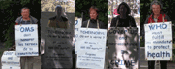
The 213° week of the vigil
in front of WHO
Complete text of this Manifesto for an independent WHO. To sign the petition online go to the bottom of this page.
The controversy surrounding WHO’s management of the A (H1N1) flu “pandemic” has shed a harsh light on the workings of this UN agency. Following the proposal of its former president, Dr Wolfgang Wodarg, the subcommittee on Health of the Parliamentary Assembly of the Council of Europe has set up a commission of enquiry to investigate the question of possible connivance between vaccine manufacturers and certain expert advisers of WHO.
We would like this concern for transparency to extend to other areas, and in particular to WHO’s relationship with the International Atomic Energy Agency (IAEA), one of whose objectives is to promote the use of civil nuclear power. Few people are aware that WHO and the IAEA signed an agreement, on 28 May, 1959 (WHA 12-40) which in practice prevents either of these two UNO agencies publicly adopting a position which could be detrimental to the interests of the other.
This agreement explains the disinformation emanating from WHO in relation to nuclear power, and notably in relation to the health consequences of the Chernobyl accident. The press release of 5 September 2005, co-signed by WHO and the IAEA, is an example. It announces a “definitive” total of fifty or so deaths and 4000 potential deaths following exposure to radioactivity after the accident, with not a word about the hundreds of thousands of liquidators from all over the USSR who cleaned up the site. And yet, of the 173,000 Russian liquidators, registered as victims following their work at Chernobyl, 10% were dead by 2001 and 30% were recognized as invalids (declaration of the Director of Health of Russia at the Kiev Conference on Chernobyl in 2001) Nothing either, on the health condition of the children in Belarus, despite the fact that, according to the Vice Minister of Health, only 20% of them were considered in “good health” in the year 2000, as against 80% in 1985.
The latest joint press release from WHO and the IAEA, dated 24 April 2009, implies that the territories affected by the accident are no longer dangerous for their populations and that all that is required is “to reassure through practical guidance” and to convince them of the need “to return to normal life”. It is against this background that the independent institute Belrad, in Minsk, Belarus, which, since 1990, has been measuring levels of radionuclides in the bodies of children and treating them with cures of pectin to reduce levels of cesium 137 has been refused subsidies requested of the EU on the grounds that: “the theme of your project is no longer relevant”.
However, a scientific study, Chernobyl : Consequences of the Catastrophe for People and the Environment, by Alexei Yablokov, Vassily Nesterenko and Alexei Nesterenko, has recently been published in an English version, by the New York Academy of Sciences. It contains an overview of 5000 studies undertaken in the contaminated countries and puts in doubt the conclusions of WHO and the IAEA.
http://www.nyas.org/Publications/Annals/Detail.aspx?cid=f3f3bd16-51ba-4d7b-a086-753f44b3bfc1
The undersigned urge WHO to defend its independence through revision of the 1959 agreement with the IAEA in order that WHO may :
• fulfil its constitutional mandate, which is “the attainment by all peoples of the highest possible level of health” and “to assist in developing an informed public opinion among all people on matters of health”
• encourage field studies on radioactive contamination by independent researchers whose work has been deliberately ignored (for example Youri Bandazhevsky), and more particularly, organize forums;
• support projects of those who struggle to reduce the effects of the catastrophe.
Manifesto initiated by the collective IndependentWHO which comprises a wide coalition of NGOs. Its objective is the independence of WHO in matters of radiation health. The action of the Collective, since 26 April 2007, is symbolized by the Hippocratic Vigils, a silent, permanent presence from 8.00 till 18.00 every working day, in front of WHO headquarters in Geneva
SIGNATORIES TO THE MANIFESTO FOR THE INDEPENDENCE OF WHO on 31st May.
Raymond Aubrac, former member of the Resistance, Paris (France)
Robert Barbault, ecologist, Professor at the University Pierre and Marie Curie, Paris (France)
Bernard Doray, psychoanalyst and anthropologist, Paris (France)
Jean-Pierre Dupuy, philosopher, Professor at Stanford University (California, USA)
Mgr Jacques Gaillot,Bishop, Paris (France)
Françoise Héritier, Professor at the Collège de France, Paris (France)
Stéphane Hessel, former French Ambassador, Paris (France)
Corinne Lepage, Member of the European Parliament, former Minister of the Environment, Paris (France)
Mother Hypandia, Abbess, Monastery of Solan, La Bastide d’Engras (France)
Danielle Mitterrand, President of the Foundation France Libertés, Paris (France)
Edgar Morin, sociologist, philosopher, Paris (France)
Rémi Pagani, Mayor of Geneva (Switzerland)
Jean-Marie Pelt, President of the European Institute of Ecology, Metz (France)
Pierre Rabhi, agro-ecologist and writer, Ardèche (France)
Michèle Rivasi, Member of the European Parliament, Valence (France)
Philippe Roch, former Minister of the Environment, Russin (Switzerland)
Jacques Testart, biologist, Paris (France)
Gérard Toulouse, physicist, member of the Academy of Sciences, Paris (France)
François Veillerette, teacher, President of the MDRGF, Vice-President of the Regional Council of Picardy (France)
Jean Ziegler, sociologist, vice-president of the Advisory Committee of the Human Rights Council, Geneva (Switzerland)
From the former USSR
Hanukova M. Abramovna, sociologist, Saint Petersburg (Russia)
Oksana Bezuglaya, student, Kiev (Ukraine)
Vlatcheslav Charskyi, representative of NGO “Club AGAT”, Bishkek (Kyrgyzstan)
Evguéni Gayev, mathematician, Institute of Fluid Mechanics, Kiev (Ukraine)
Helen Goncharenko, Professor of Radiobiology, Moscow (Russia)
Paul Igor Hadjamberdiev, physician and ecologist, Bishkek (Kyrgyzstan)
Albert Kalashnikov, regional spokesperson (Amur) for the “Yabloko” Party, Blagoveshchensk (Russia)
Natalia Kalinina, assistant professor in the Faculty of Journalism at Amur State University, Blagoveshchensk (Russia)
Julia Kalmykova, project leader of the NGO, the Ecological Museum, Karaganda (Kazakhstan)
Valeriya Kotovets, engineer and journalist, Volgograd (Russia)
Feodor V. Kronikovsky, retired, Roshchino (Russia)
Yurij B. Kudriashov, Professor of Radiobiology, Moscow (Russia)
Soniya Kurbanova, Tajikistan Social-Ecological Union, Dushanbe (Tajikistan)
Anatoly Lebedev, Regional Support Committee,Vladivostok (Russia)
Ludmila Morozova, ecologist, Petrozavodsk (Russia)
Dr. Iaroslav Movchan, lecturer and naturalist, Kiev, (Ukraine)
Valeria I. Naydich, radiobiologist, Moscow (Russia)
Irina I. Pelevina, radiobiologist, Moscow (Russia)
Vitaly Servetnik, ecologist, Murmansk (Russia)
Anatoli Shpunt, physicist and ecologist, Republic of Altay (Russia)
Sergey Simak, co-spokesperson of the International Social-Ecological Union, Samara (Russia)
Alexey Toropov, ecologist, regional director of the NGO, the Siberian Ecological Agency, Tomsk (Russia)
Alexey Zimenko, ecologist, Moscow (Russia)
And from elsewhere
Galia Ackerman, journalist (France)
Paul Ariès, political commentator, writer, editor of Sarkophage, Paris (France)
Jean-François Bernardini, singer and composer (I Muvrini), Bastia (France)
Jean-Paul Besset, Member of the European Parliament, Brussels (Belgium)
Jean-Claude Besson-Girard, editor of Entropia, Malaucène (France)
Martine Billard, Paris deputy (France)
Marie-Christine Blandin, Senator (Green Party) for Nord (France)
Dominique Bourg, philosopher, Professor at the University of Lausanne, Pully (Switzerland)
Claude Bourguignon, agronomist, Côte-d’Or (France)
Jacques Boutault, Mayor of the 2nd Arrondissement in Paris (France)
Marcello Buiatti, Professor of Genetics at the University of Florence (Italy)
Vincent Cheynet, Editor in chief of La Décroissance, Lyon (France)
Arnaud Chiffaudel, physicist, Igny (France)
André Cicolella, Researcher in Environmental Health and President of the Réseau Environnement Santé, Paris (France)
Philippe Derudder, economist, Cahors (France)
Philippe Desbrosses, agriculturalist, Doctor of Environmental Science and writer, Millançay (France)
Arnaud Desjardins, writer, Saint-Laurent-du-Pape (France)
Jean-Claude Duclos, Chief Heritage Conservation Officer, Grenoble (France)
Lydia Gabucca-Bourguignon, engineer, Côte-d’Or (France)
Josiane Hay, lecturer, Joseph Fourier University, Grenoble (France)
Guy Kastler, peasant farmer, La Caunette (France)
Alfred Körblein, physicist, Nuremberg (Germany)
Bernard Langlois, journalist, Paris (France)
Paul Lannoye, Honorary Member of the European Parliament, member of the European Committee on Radiation Risk (ECRR), Namur (Belgium)
Bertrand Meheust, philosopher, Professor of the History of Psychology, Mézilles (France)
Yves Michel, publisher, Gap (France)
Corinne Morel Darleux, Regional Councillor (PG) Rhône-Alpes, Die (France)
Jacques Neirynck, national Councillor, Écublens (Suisse)
Fabrice Nicolino, journalist, Paris (France)
Jean-Luc Parouty, Research Engineer (CNRS), Grenoble (France)
Elena Pasca, philosopher and Germanist, (France)
Richard Pétris, director of the peace scholl (France)
François de Ravignan, former researcher at INRA, agro-economist and writer
Xavier Renou, association leader, Paris (France)
Laurent Samuel, journalist, Paris (France)
Gilles-Éric Séralini, Professor of Molecular Biology at the University of Caen (France)
Devinder Sharma, writer, researcher and ecologist, New Delhi (India)
Yves Sintomer, Professor of Political Science, Paris (France)
Annick de Souzenelle, writer, Rochefort-sur-Loire (France)
Heinz Stockinger, academic, Salzburg (Austria)
Jonathan Upjohn, retired from the Joseph-Fourier University in Grenoble (France)
Rose-Marie Upjohn, retired professor, Grenoble (France)
Alain Trautmann, Researcher at CNRS, Paris (France)
Christian Van Singer, national Councillor, La Croix (Switzerland)
Christian Vélot, lecturer in molecular genetics, University of Paris-Sud 11 (France)
Michel Wilson, local government officer, Lyon (France)
Françoise Zonabend, ethnologist, Paris (France)

 Site map
Contact the Webmaster
Site map
Contact the Webmaster